WordPress does not release on a rigid schedule. It never has. But the pattern of major releases over the past few years tells a story worth paying attention to, not because the releases themselves are problematic, but because of what the rhythm reveals about how the platform is evolving and what that means for the people responsible for keeping production sites stable.
This is not a criticism of the WordPress project. It is a practical read of what careful site managers should take from observable release patterns, and how those patterns should inform the way serious sites are maintained.
How the WordPress Release Cycle Has Changed
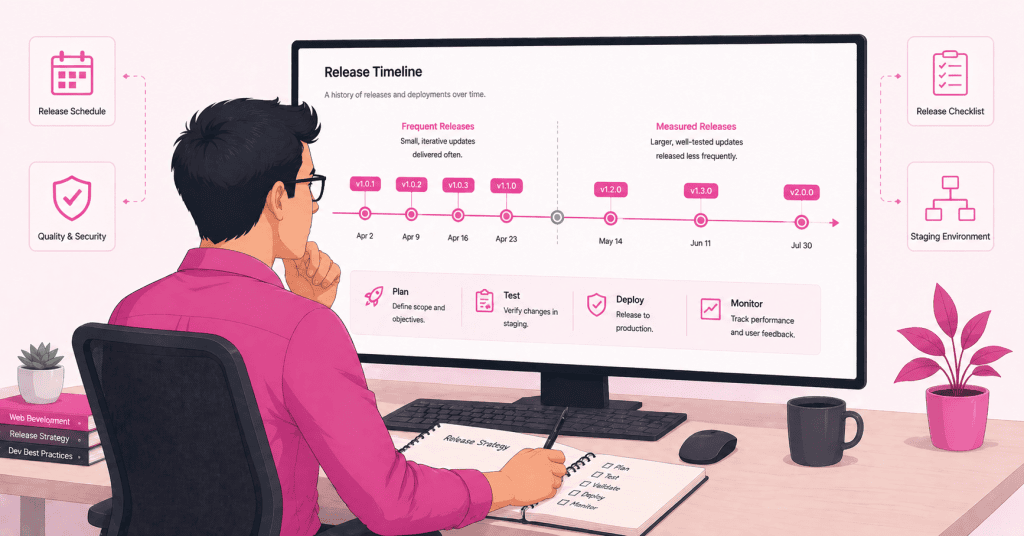
For most of its history, WordPress aimed for a cadence of two to three major releases per year. That cadence was never perfectly consistent, but it was predictable enough that experienced teams could plan around it. Releases arrived, introduced new features, and were absorbed into the ecosystem over the following weeks.
More recently, that pattern has shifted. Major releases have been delayed more frequently. The scope of individual releases has grown as the Gutenberg project continues expanding the block editor into areas that affect site structure, template editing, and content workflows that go well beyond simple post writing. The gap between a major release and the point where the ecosystem around it stabilises has lengthened.
The platform has transitioned from a simple publishing tool into a complex application framework. Modern WordPress now includes the block editor, full site editing, global styles, theme.json behavior, and REST APIs. These layers mean that a core update is no longer just a change to the dashboard; it is a change to the fundamental architecture of the site’s layout and data handling.
Larger Releases Mean Longer Stabilisation Windows
When a WordPress release is primarily a maintenance update or a focused feature addition, the ecosystem adjusts quickly. Plugin and theme authors release compatibility updates within days. The risk window is short.
When a release ships significant changes to core systems, such as changes to how templates are structured, how blocks interact with themes, or how the editor handles data, the stabilisation period is longer. Plugin authors need more time. Theme frameworks need updates. Builders need to verify that their output still behaves correctly against the changed core. That process does not happen overnight, and the risk of applying an update before it is complete is real.
The Gutenberg Roadmap Creates a Moving Target
The block editor was introduced in WordPress 5.0 and has been expanding in scope with every subsequent major release. Full Site Editing, patterns, template parts, and the ongoing development of the site editor have changed what WordPress core means for a site that uses a block-based theme or builder.
For sites that do not use block themes and are built on classic themes or established page builders, many of these changes are effectively invisible at the implementation level. But they are not invisible at the update management level. Each major release still needs to be assessed, tested, and applied carefully, even if the visible changes are minimal, because the underlying core is changing in ways that can interact unpredictably with plugin hooks, theme functions, and custom code.
What This Means for How Sites Should Be Managed
The release cycle is not something most site owners think about directly. It surfaces as a practical reality when something breaks after an update, or when a host applies an auto-update that introduces a conflict the site owner was not prepared for. Understanding what drives that risk is useful context for making better decisions about how a site is maintained.
Automatic Updates Are a Risk Management Decision, Not a Default
WordPress and most managed hosting environments offer automatic updates for core, plugins, and themes. The convenience is real. So is the risk.
An automatic update applied to a site with complex plugin dependencies, a custom builder implementation, or a WooCommerce installation is not a guaranteed safe operation. The update may apply cleanly. It may also introduce a conflict that takes the site down at a moment when nobody is monitoring it. The question is not whether to update, but whether the update is being applied with any review process attached to it, or simply being pushed through on a schedule because the setting is enabled.
Mature site management treats automatic updates as a tool that works in specific contexts, not as a substitute for a maintenance process. Minor security patches are often safe to automate. Major releases and significant plugin updates are worth reviewing before they touch a production environment.
Testing Environments Become More Valuable as Releases Grow in Scope
The argument for staging environments is not new. But it becomes more compelling as individual WordPress releases carry more structural weight. A major release that ships changes to how templates are handled, how blocks are registered, or how the editor stores data is a release where the cost of skipping a staging test is higher than it was three releases ago.
For sites where the front end is built on a block theme or where the editor is used for complex content workflows, a staging environment is not optional infrastructure. It is the difference between discovering a conflict on a test site and discovering it on the live site in front of real visitors.
The Ecosystem Lag Is a Real Consideration
There is a consistent pattern in how the WordPress ecosystem responds to major releases. Core ships. A wave of compatibility updates follows from major plugin authors. A second wave follows from smaller plugins and add-ons. Somewhere in that second wave are the plugins that do not update at all, and the conflicts that only surface when specific combinations of updated and not-yet-updated components interact.
Applying a major WordPress update on release day is almost never the right call for a production site with a complex plugin stack. Waiting one to two weeks while the ecosystem stabilises, monitoring the changelog and support forums for early conflict reports, and then applying the update with a tested backup in place is a more defensible process. It is also a more boring one, which is exactly what production site management should be.
What Careful Site Managers Actually Do Differently
The release cycle creates a rhythm. Careful site managers respond to that rhythm with a process. Everything else is reactive.
They Track What Is Coming Before It Arrives
WordPress release development is largely public. Beta releases, release candidates, and developer notes are published well in advance of the final release. A team that tracks those notes knows what is changing before it changes, can identify whether upcoming changes affect their specific implementation, and can begin staging tests before the release ships rather than after.
This is not a significant time investment. Reading the release notes for an upcoming major version takes thirty minutes. The return on that thirty minutes, in the form of reduced emergency response time when something breaks, is substantial.
They Separate Update Types in Their Process
Not all updates carry equal risk. A minor security patch to a small utility plugin is a different operation from a major WooCommerce release or a WordPress core update that ships template system changes. Treating them identically produces a process that is either too cautious for low-risk updates or too casual for high-risk ones.
Separating updates by risk level, applying lower-risk updates on a regular schedule and handling higher-risk updates with more deliberate review and staging, is one of the clearest markers of a maintenance operation that has been thought through rather than inherited.
They Maintain a Backup They Have Actually Tested
A release cycle creates regular moments where something could go wrong. Each of those moments is only manageable if there is a clean, tested, restorable backup in place before the update runs. Not a backup that is assumed to exist. A backup that has been restored to a test environment and confirmed to work.
The teams that handle WordPress updates without drama are almost always the teams that made the backup their first step, not an afterthought.
The Broader Point
The WordPress release cycle is not a problem to be solved. It is a reality to be managed. The platform is actively developed, the ecosystem around it is large and uneven, and the interaction between core updates and the specific combination of plugins and customisations on any individual site is something that can only be understood by testing rather than assumed.
What the recent release patterns confirm is that the cost of not having a process has increased. Larger releases, a longer-running editor transformation, and a more complex ecosystem mean that the gap between a well-maintained site and a poorly-maintained one is wider than it was five years ago. The fundamentals have not changed. The stakes of ignoring them have.
It is important to distinguish between development stability and operational stability. The WordPress core team may release a version that is technically stable and bug-free, but it may not be operationally stable for your specific site until your theme and mission-critical plugins have published their own compatibility updates. A mature process accounts for both.
If your site does not currently have a structured process around WordPress updates and releases, WPFellow can help put one in place. Take a look at our WordPress Care Plans.