Every few months a new comparison surfaces. WordPress versus Webflow. Bricks versus Elementor. Self-hosted versus managed. Each comparison implies the same thing: that choosing the right platform is the primary lever for getting a fast, stable, well-running site.
It is not. Platform choice matters, but it matters less than most of the conversation around it suggests. The sites that perform well and stay stable over time share a set of qualities that are largely independent of which CMS or builder was used to create them. The sites that struggle share a different set of qualities, and those qualities are also largely independent of platform.
This is worth understanding clearly, because the wrong conclusion leads to expensive decisions. Rebuilding a site on a new platform to solve problems that are actually rooted in how the site is managed will reproduce those problems on the new platform. The tool changes. The outcome does not.
What Platform Choice Actually Determines
Platform choice is not irrelevant. It sets boundaries. It determines what is easy, what is possible, and what requires significant effort to achieve. Those boundaries matter and they should inform the decision. But boundaries are not outcomes.
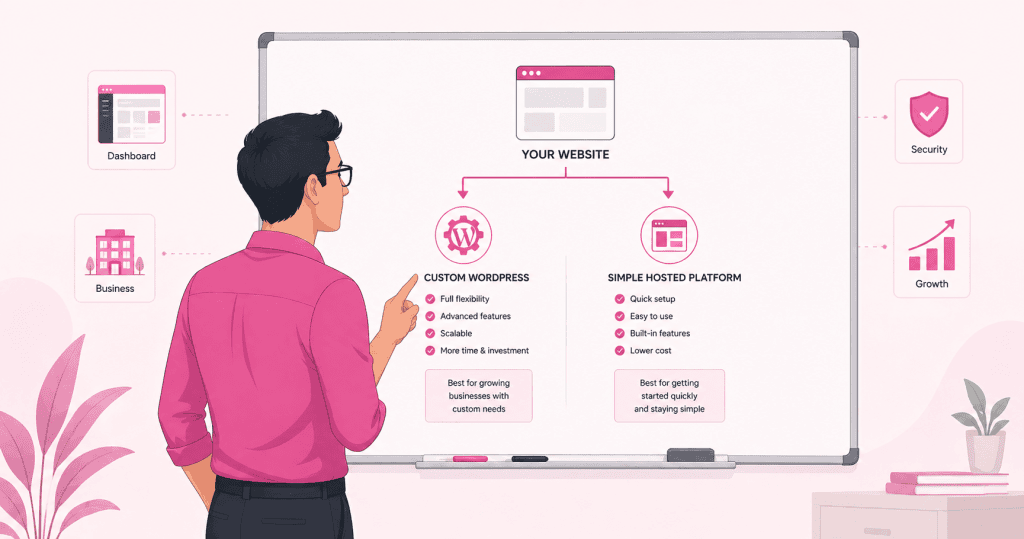
Each platform provides a different starting position. WordPress offers flexibility, ownership, and deep customization. Webflow provides a controlled visual environment with managed hosting. Shopify offers a mature, specialized commerce framework. These are real differences in capability, but they do not determine whether the final site is fast or stable.
It Sets a Performance Ceiling, Not a Performance Floor
Some platforms produce leaner output than others by default. A site built with Bricks starts from a cleaner baseline than one built with a heavily extended Elementor setup. A headless implementation can deliver faster time-to-first-byte than a traditional WordPress stack on shared hosting. These differences are real.
What they determine is the ceiling of what is achievable with skilled implementation, and the floor of what is produced by a careless one. They do not determine where a specific site actually lands. A Bricks site with unoptimised images, no caching, and a slow server is slower than a well-configured Elementor site on quality managed hosting. The platform advantage is real but not unconditional.
It Shapes the Maintenance Burden
Different platforms distribute the maintenance responsibility differently. A SaaS platform handles infrastructure, security patching at the platform level, and uptime. WordPress on self-managed hosting puts those responsibilities on the site owner or their agency. Neither arrangement is inherently better, but they require different things from the team managing the site.
A platform that removes infrastructure responsibility does not remove the need for maintenance discipline. Content still needs managing. Plugins or apps still need reviewing. Performance still drifts if nobody is watching it. The form of the maintenance obligation changes with platform choice. The fact of it does not.
It Influences How Easy It Is to Make Good Decisions
Some platforms make it easier to do the right thing. A managed WordPress host that enforces current PHP versions, applies server-level security, and provides one-click staging removes several categories of decision from the site owner’s plate. A page builder that generates clean, semantic HTML makes performance optimisation easier than one that does not.
These affordances are worth considering in a platform decision. They are not a substitute for the decisions that remain. A well-chosen platform with poor implementation is still a poorly performing site.
What Actually Determines Performance and Stability
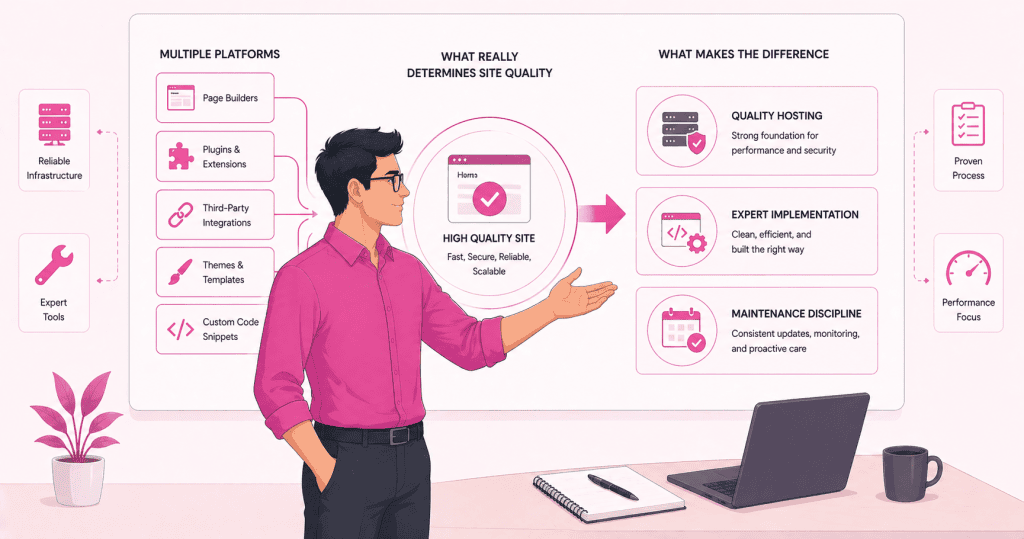
The factors that most consistently predict whether a site performs well and remains stable over time are not platform decisions. They are execution and operational decisions made after the platform choice, often long after.
Hosting Quality and Configuration
The server environment is the foundation everything else runs on. A fast, clean implementation on an underpowered shared host will underperform a more average implementation on quality managed infrastructure. TTFB, the time from request to first byte of server response, is almost entirely determined by the hosting environment before any front-end optimisation has been considered.
This is one of the most reliably under-weighted factors in performance conversations. Front-end scores are visible and easy to share. Hosting quality requires more investigation to evaluate, so it tends to get less attention than it deserves. The sites that feel fast consistently are almost always on infrastructure that was chosen with performance in mind, regardless of what builder or CMS sits on top of it.
Implementation Quality
How something is built matters more than what it is built with. A WordPress site with a well-structured template hierarchy, a lean plugin stack, correctly sized images, a configured caching layer, and clean custom code will outperform and outlast a WordPress site built carelessly, regardless of whether both used the same theme or builder.
The same applies across platforms. A Webflow site with dozens of interactions, unoptimised animations, and no attention paid to how assets load is not fast because it is Webflow. A WordPress site with a disciplined front end and no unnecessary overhead is not slow because it is WordPress. The implementation is the variable.
Maintenance Discipline Over Time
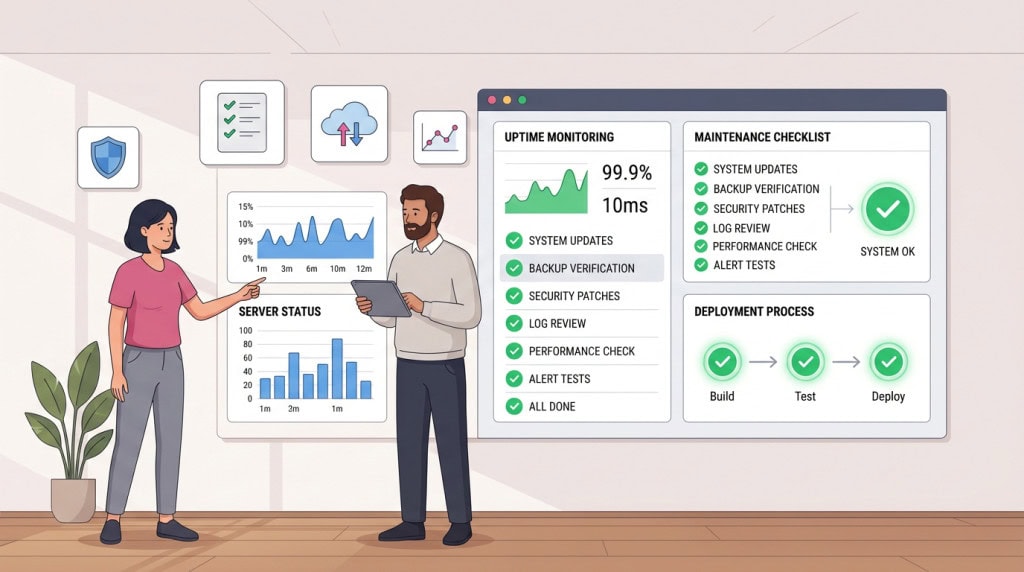
A site that is well-built but never maintained is not a stable site. It is a site in the early stages of becoming one. Plugins drift out of date. PHP versions age past support. Performance erodes as the database grows and nobody runs a cleanup. Security exposure accumulates quietly.
The sites that remain stable over two, three, and five year periods are the sites where someone has been paying attention throughout. Not dramatically. Not expensively. Just consistently. Updates reviewed and applied. Backups tested. Performance checked periodically. Security baseline maintained. That consistency is what separates a site that ages well from one that accumulates problems until they force a response.
The Skill and Judgment of the People Involved
Platforms do not make decisions. People do. The judgment applied at every stage of a site’s life, from the initial architecture to the choice of which plugins to install, to how updates are handled, to whether performance issues get investigated or ignored, determines more about the site’s quality and longevity than any tool involved.
This is true at the build stage, where an experienced developer makes different choices than an inexperienced one on the same platform. It is true at the maintenance stage, where a team that understands update risk manages it differently from one that does not. And it is true at the strategy stage, where someone with genuine experience can identify when a site needs a rebuild rather than another round of patches, and when it does not.
The Practical Implication
The practical consequence of this is that platform evaluation and platform switching deserve less weight in performance and stability conversations than they typically receive, and execution quality deserves more.
A site that is struggling is usually struggling because of how it was built, how it has been maintained, or what it is running on, not because the wrong CMS was chosen. Addressing those root causes on the current platform is usually faster and cheaper than rebuilding on a new one, and it produces more durable results because it changes the underlying practices rather than just the tool.
Platform choice is a real decision with real consequences. It is one input into a site’s long-term performance and stability. It is not the dominant one. The teams and site owners who understand that distinction make better decisions, spend their budgets more effectively, and end up with sites that actually perform the way they were intended to.
If your site is underperforming and you want an honest assessment of what is actually causing it, WPFellow can help. Take a look at our WordPress Speed Optimisation service or get in touch to discuss your site.