Most WordPress sites do not get rebuilt because something catastrophic happened. They get rebuilt because a series of smaller decisions, each individually reasonable, accumulated into a site that has become too expensive to maintain, too slow to fix properly, and too fragile to trust with another round of updates.
Knowing when a site has crossed that threshold is genuinely useful. Patching a site that needs rebuilding is not a neutral decision. It consumes time and money that would be better spent building something that will not need the same conversation again in twelve months.
The Difference Between a Repairable Site and a Fragile Site
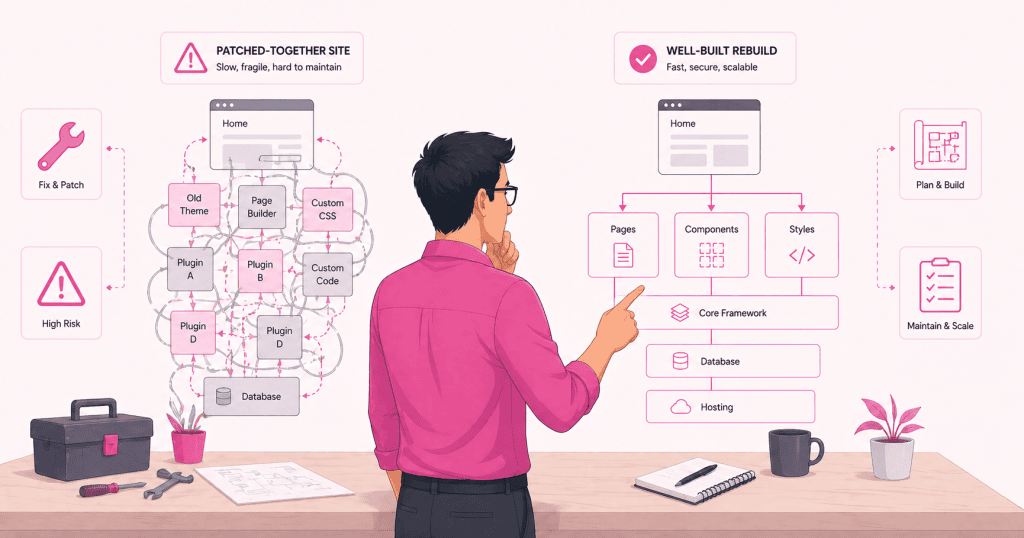
A repairable WordPress site has problems, but those problems are isolated. Maybe a few plugins need replacing, images need optimization, PHP needs upgrading, or templates need cleanup. The site may be imperfect, but the structure still makes sense and the important parts can be improved without pulling everything apart.
A fragile site behaves differently. Problems are interconnected. Changing a style in the footer breaks the layout on the shop page. Updating a minor plugin causes a critical error in the checkout. When a site becomes fragile, even “simple” fixes become high-risk operations.
The Case for Patching First
Before making the case for a rebuild, it is worth being honest about when patching is the right call. Most sites with problems do not need to be rebuilt. They need targeted work from someone who understands what they are looking at.
A site with a slow page load that stems from a misconfigured caching layer, unoptimized images, and a bloated plugin or two can be significantly improved without touching the underlying structure. A site with recurring login spam can usually be hardened at the security layer without architectural changes. A site with a broken contact form or a payment gateway issue almost certainly does not need a rebuild.
Patching makes sense when the problems are specific and addressable, when the underlying structure is sound, and when the cost of targeted fixes is proportionate to the value the site delivers. The rebuild conversation only becomes relevant when those conditions stop being true.
Signs the Site Has Moved Beyond Patching
These are not arbitrary thresholds. They are patterns that, individually or in combination, indicate a site has accumulated enough structural debt that targeted fixes are no longer the most efficient path forward.
The Site Breaks Repeatedly After Routine Updates
A well-built site can absorb routine updates without drama. When a site consistently breaks after plugin updates, after WordPress core releases, or after minor theme changes, that is a signal that something in the underlying structure is too fragile to coexist with a normally maintained environment.
This pattern often traces back to heavy customization on top of a theme framework that was not designed for it, a builder version that has drifted so far from its original configuration that updates no longer apply cleanly, or dependencies between plugins that were never managed properly. Each patch fixes the immediate breakage without addressing the brittleness that caused it. The next update creates the same problem in a slightly different place.
Performance Cannot Be Fixed Without Rebuilding What Causes It
Some performance problems are infrastructure problems. A slow server, an unconfigured cache, images that have never been optimized. These are fixable without a rebuild.
Other performance problems are structural. A site built on a theme that outputs several hundred kilobytes of unused CSS, a builder that generates deeply nested markup for every element, a plugin stack that loads twenty scripts on every page regardless of whether they are needed. These problems cannot be resolved by a caching plugin or a CDN. They live in the architecture itself, and addressing them properly means rebuilding the front end.
When a site has been through one or two rounds of performance optimization and the gains are marginal because the underlying output is fundamentally heavy, that is a sign the site’s performance ceiling is determined by its structure, not by any remaining configuration improvements.
The Codebase Has Become Unreadable to Anyone New
A site that only one person understands is a liability. When a developer inherits a WordPress site and cannot follow the logic of how it was built, cannot identify what a custom function does without tracing it through multiple files, or cannot safely update a plugin without triggering unpredictable behavior, that codebase has crossed into genuinely fragile territory.
This often happens on sites that were built quickly, patched repeatedly, and handed off without documentation. The original structure gets buried under layers of workarounds. What looks like maintenance work becomes archaeology. At some point, the safest and fastest path is to build something clean rather than continue excavating something that was never built to last.
Technical Debt and Plugin Overlap
This pattern is common on sites that have been maintained reactively over several years. Plugins get installed to solve immediate problems without reviewing what is already there. Features get disabled but the code stays. A plugin that handles one part of a job sits alongside another that handles a slightly different part of the same job, and neither gets removed because removing things feels risky.
The result is a database carrying years of accumulated weight and a plugin stack where no single person has a clear picture of what everything does or why it is there. Optimizing speed in that environment is difficult because the overhead is distributed across too many places to address cleanly. A rebuild with a deliberate, minimal stack removes that weight at the source rather than working around it indefinitely.
The Site No Longer Reflects How the Business Operates
Some sites need a rebuild not because they are technically broken but because they have drifted so far from the current business that maintaining them is working against the organisation rather than for it.
A site built for a business that has since changed its services, restructured its customer journey, or moved into new markets may still function technically while being entirely misaligned with what the business actually needs to communicate. At some point, adapting that site becomes a sustained exercise in working around a structure that was designed for something else. A rebuild gives the business a foundation built for what it is now, not what it was when the site was originally scoped.
The Security Surface Has Become Unmanageable
A site that has accumulated abandoned plugins, nulled or outdated themes, multiple user accounts with no clear ownership, and a plugin stack that has never been audited is not just technically messy. It is a security liability that is difficult to harden without removing large parts of what is there.
Hardening works well when there is a defensible baseline to work from. When the baseline itself is compromised by years of unmanaged additions, the hardening work becomes a rearguard action against a surface area that keeps expanding. Rebuilding with a clean, minimal, well-understood stack removes the exposure at the root rather than managing it at the edges.
What a Rebuild Actually Involves
A rebuild is not always a complete start from scratch. In many cases it means replacing the front end and restructuring the templates while preserving the content, the domain history, and the SEO equity the site has accumulated. Redirects handle any structural URL changes. The database content migrates cleanly. What changes is the implementation layer.
In other cases, particularly where the content itself has become disorganised or the information architecture no longer serves the user, a fuller rebuild including content restructuring is the better path. That is a larger scope conversation, but it is still a planned and manageable project rather than an open-ended patching exercise.
The distinction worth making is between a rebuild as a panic response and a rebuild as a deliberate investment. The former happens when a site finally fails in a way that forces the issue. The latter happens when someone looks honestly at what continued patching is costing in time, money, and risk, and concludes that the rebuild pays for itself faster than the alternative.
How to Frame the Decision
The most useful question is not whether the site is broken. Many sites that need rebuilding still function adequately. The more useful question is whether continued maintenance of the existing site is a good use of the budget being spent on it.
If targeted fixes are consistently absorbing time without producing stability, if performance work is producing diminishing returns because the structure limits what is possible, or if the site is visibly misaligned with where the business is now, those are the conditions that make a rebuild the more rational choice.
A good developer or agency should be able to give an honest assessment of which category a site falls into, and that assessment should not be shaped by which answer generates more billable work in the short term.
If you are not sure whether your site needs targeted fixes or a proper rebuild, WPFellow can take an honest look and tell you which approach actually makes sense. Get in touch to discuss your site.